
Party at Our House: Public Spending, Protest, and the Politics of the 2026 World Cup in Mexico
Source: Wikimedia Commons
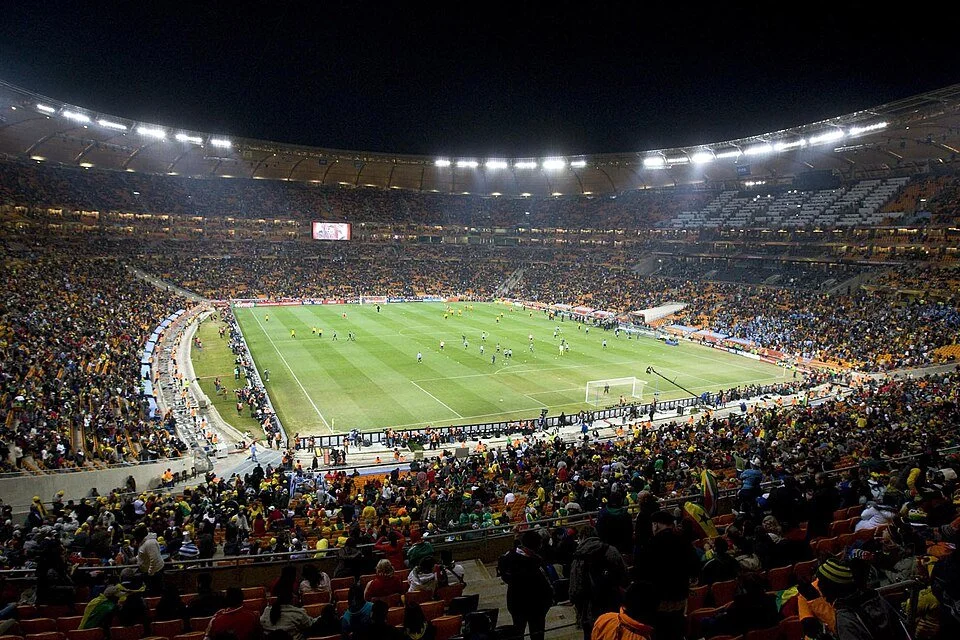
The 2026 FIFA World Cup has been the event of the year for many soccer fans. All across the globe, people have been patiently and eagerly waiting to support their countries as they take to the field, however, amid the excitement Mexico City presents a striking contrast to the global dynamic. The hosting of the World Cup usually projects great promise for the economic prosperity of the host country by creating jobs and expanding tourism.Qatar, the last World Cup host, saw an estimated $2.3–4.1 billion in tourism and broadcasting revenues in 2022.However, the citizens of Mexico did not receive this promise. The 2026 FIFA World Cup opened in Mexico City on June 12 amid a heavy police presence and mass demonstrations, a surprising reality as opposed to the celebratory images that officials projected.While the tournament promises economic returns, critics argue that billions in public spending on the event have come at the direct expense of workers, the poor, and families of the disappeared.
Mexico City alone has contributed to 1.3 billion USD to events regarding the World Cup itself, spanning more than 2,000 projects. There were large scale public financing projects carried through by the federal government in the three host cities; they directed hundreds of millions more toward mobility in Mexico City, Guadalajara, and Monterrey, with resources allocated to transportation, accessibility, and public transportation. However, the contrast in public investment as a share of GDP is what has fueled much outrage among Mexican citizens.Public investment as a share of GDP has fallen sharply from 4.5% in 2014 to 3.0% in 2024 and federal public sector interest payments hit a 20-year high in early 2025. The differences in tournament spending compared to the funding cuts in health, education, and housing is what has fueled popular anger in the region
Due to the vast nature of budget cuts, many different groups of citizens have protested, each with their own qualms with the federal government. The teacher’s union,Coordinadora Nacional de Trabajadores de la Educación, (CNTE) marched to the stadium opening day, demanding an increase in wages and objecting to austerity cuts alongside the World Cup. The cuts have also had consequences beyond wages. Reduced funding for search commissions has hampered efforts to locate missing persons across the country. Families of the disappeared joined marches urging the Sheinbaum government to address Mexico's ongoing crisis of missing persons. The scale of the crisis is staggering, over 132,000 people remain missing with roughly 40 people disappearing every day since Steinbaum’s government, nearly double her predecessor’s. Critics have argued that World budgeting priorities in accordance with the World Cup has left search commissions underfunded, accelerating the crisis. Gen Z has also taken to the stage, protesting against the increased displacement and gentrification of neighborhoods around stadiums. More than 20,000 households are displaced per year in Mexico City due to rising housing prices and the World Cup seems to have accelerated this trend. For example, In Santa Úrsula Coapa, the Indigenous village adjacent to Azteca Stadium, residents have organized since 2021 against a real estate development project, citing risks of dispossession, water privatization, and displacement. These protesters blocked roads and took down World Cup installations, leading the Sheinbaum government to acknowledge that the main fan festival at Zócalo was at risk. The sense of exclusion extends beyond neighborhoods. Many of the workers who built and staffed the tournament can barely afford to attend the events themselves. Ticket prices are unaffordable to a vast majority of Mexican citizens and serve fundamentally as a spectacle for foreign visitors. Without actual access to the event, ordinary citizens feel a disruption caused by the event.
The arguments and concerns of citizens have been countered by numbers released by the government and FIFA itself. Officials tout projected tourism revenue of ~$1 billion and a broader economic impact of $4+ billion for Mexico. Additionally, a “transparency platform” was launched in order to give citizens an idea on how public funds were being used, countering any arguments of opaqueness. FIFA has also predicted that this project will generate about $13.9 in global expenditure, pushing that this event will ultimately further the Mexican economy.
The 2026 World Cup puts Mexico on a global stage, however the tension between them remains unresolved due to the question of who actually benefits from the money. Many analysts warn that economic numbers may fall well beneath the projections and the social costs of the project are already being felt. The voices on the streets of Mexico City act as a barometer of the deeper discontent with the Sheinbaum administration.