
The Strategic Importance of Greenland in U.S. International Relations
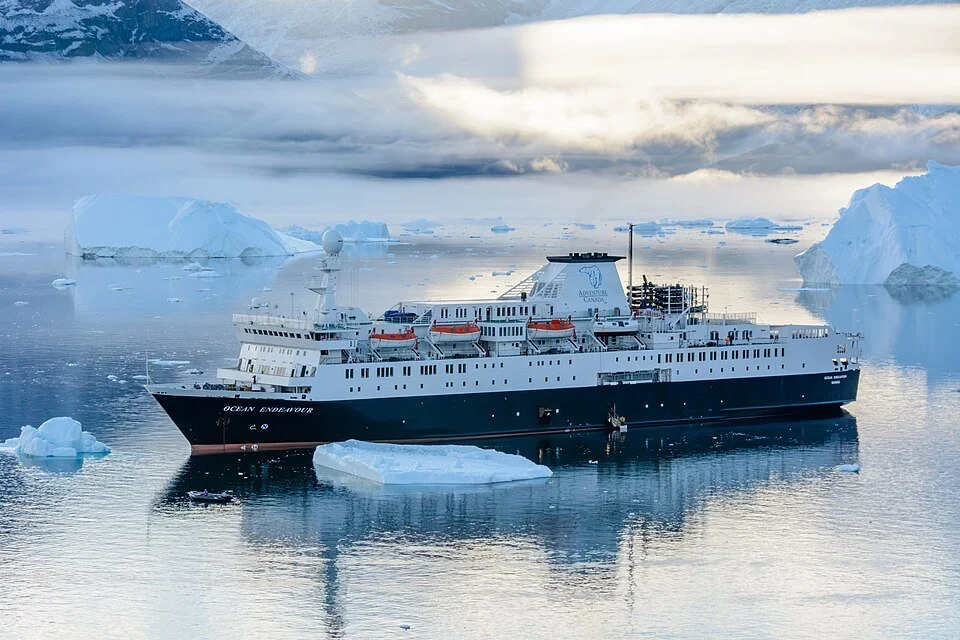
Source: Wikimedia Commons, MS Ocean Endeavour at Karrat Fjord, Greenland
Starting in his first term, Donald Trump frequently reiterated his desire for Greenland to become part of the United States. In January 2026, he intensified this pressure and stated that military action was a possibility for obtaining the island. This marks a stark escalation in tensions between the United States and Europe. The United States has a long history with Greenland, and the island is strategically important for the U.S. However, Trump’s methods threaten to drive a wedge in U.S.-Europe relations, one that could have long-term consequences.
Background
In 982 CE, Erik the Red, a Norwegian, settled on Greenland, marking the beginning of Nordic interaction and settlement of the island. The Norse remained in Greenland for centuries, until they disappeared at the start of the 15th century. While the reasons for the disappearance are unknown, theories include a colder climate and conflict with the Inuit.
In 1721, Hans Egede, a Danish-Norwegian missionary, founded a trading company and a Lutheran mission near present-day Nuuk, Greenland, marking the beginning of Greenland's colonization. In 1776, the Danish government assumed a full monopoly of trade with the country and closed the coast to foreign access. When the monarchy of Denmark and Norway split in 1814, Denmark kept Greenland.
Following the end of World War II, the United Nations pushed for decolonization in Greenland. Denmark responded by abolishing the Royal Greenland Trading Company, integrating the island into the Kingdom of Denmark, and implementing local reforms. Denmark granted home rule to Greenland in 1979, allowing for the formation of the Greenlandic Parliament. In 2009, Greenland gained the right to self-rule, establishing that the decision for independence now rested with the Greenlandic people. Today, the Inuit, a group of Indigenous people, make up nearly 90% of Greenland’s population, meaning the Greenlandic people are also protected under international law that offers protections to Indigenous peoples. These laws reinforce the principle that the independence of Greenland can only be determined by the people of Greenland.
Since the 21st century, Greenland has increased its autonomy, leading to calls for independence. Currently, Greenland governs itself in most domestic matters, including education, health, and natural resources, but Denmark retains control over defense and foreign affairs. However, Greenland is largely dependent on Danish financial and military support, meaning assistance would need to continue after independence.
U.S. Interests in Greenland
The U.S. has long been involved with Greenland. When the Germans occupied Denmark during World War II, Greenland fell under the protection of the United States out of concern that Germany would invade the island. Throughout the war, the U.S. established bases on the island from which Allied forces could launch attacks on German submarines. Furthermore, there were unique opportunities to gather meteorological intelligence for weather forecasting, which helped the Allies plan military operations with desirable weather conditions. Therefore, after World War II, it was clear that the Arctic was a region of strategic importance.
In 1950, Denmark agreed to allow the U.S. to regain the use of Thule Air Base, as part of a NATO Cold War defense strategy. During the Cold War, the U.S. tracked Russian missiles, bomber planes, and nuclear-armed submarines from Greenland. Today, the U.S. only has one base remaining on the island, Pituffik Space Base, which supports missile warning, missile defense, space surveillance missions, and satellite command and control.
Starting in his first term, Trump proposed acquiring the island. In late 2024, 2 weeks before the start of his second term, Trump floated the idea of using military force to take control of Greenland. While Trump’s first-term statements were largely dismissed, the threat of military control prompted strong condemnation from Danish Prime Minister Mette Frederiksen and Greenlandic Prime Minister Mute Egede. Throughout 2025, relations between the U.S., Greenland, and Denmark continued to deteriorate.
There are many reasons Greenland is strategically important to the United States. Trump has voiced securing mineral wealth, including oil, natural gas, and rare earth minerals, as a basis for acquiring the island. With China producing 70% of the world’s rare earth elements, finding a new source is of great importance to the United States. Furthermore, Greenland lies between the U.S. and Europe, linking the Arctic to the Atlantic Ocean. This makes the island essential for controlling access to the North Atlantic, for both trade and security purposes. With climate change and melting ice caps, new shipping routes will open up across the Arctic. Additionally, U.S. officials are increasingly focused on preventing Russian and Chinese adversaries from gaining a lasting foothold in the region. To reach the North Atlantic, Russian maritime forces must pass through the Greenland-Iceland-UK gap, making this area critical to monitoring Russia. Greenland also serves as a base for U.S. nuclear warning systems.
The January Crisis
Following Trump’s military raid on January 3, 2026 to capture Venezuelan President Nicolás Maduro, talks within the administration quickly turned to Greenland. Throughout this time, Trump claimed that Greenland was increasingly surrounded by Russian and Chinese naval activity and that Denmark lacked the capacity to defend it. The Trump Administration stated it was exploring options, including utilizing the U.S. military, to acquire Greenland.
On January 6, the leaders of Denmark, France, Germany, Italy, Poland, Spain, and the United Kingdom issued a Joint Statement on Greenland declaring that Arctic security must be achieved together with all NATO allies. Furthermore, they stated that the future of Greenland was a matter for the people of the island and Denmark, not the United States. With no signs of Trump backing down, more than a half-dozen European countries deployed military forces to Greenland to deter U.S. military actions.
Following this, Trump threatened 10% tariffs on any country that opposed his action in Greenland, specifically the United Kingdom, Denmark, Norway, Sweden, France, Germany, the Netherlands, and Finland. These tariffs triggered an emergency meeting of representatives from European countries. This prompted French President Emmanuel Macron to ask the European Union to activate its anti-coercion instrument to restrict U.S. access to the EU market. Furthermore, lawmakers in the European Parliament blocked a vote to ratify a U.S.-European trade deal.
Markets plummeted, and relations deteriorated for the next few days until Trump and NATO Secretary General Mark Rutte agreed on a deal regarding Greenland. While the deal is not finalized, Trump dropped the tariff threat. Some potential parts of the deal include strengthening U.S. deployments to Greenland, using Greenland for increased missile defense, and increasing U.S. investment in Greenland.
Most Greenlanders are opposed to an American takeover of the island, with thousands in both Greenland and Denmark participating in protests to oppose American rule. A 2025 poll showed that 85% of Greenlanders did not want to be part of the United States, and Jens-Frederik Nielsen, the prime minister of Greenland, has frequently condemned Trump’s rhetoric. In addition, three-quarters of Americans oppose the U.S. attempting to take control of Greenland, demonstrating that this is not a popular idea even in the United States.
Conclusions
Six months later, negotiations continue, but tensions remain. Currently, the U.S., Denmark, and Greenland are negotiating through a working group to find a way forward. However, a New York Times investigation found that through these talks, the U.S. is aiming for a greater role in Greenland, in military, investment, natural resources, and other areas, which impedes Greenland's sovereignty. In May 2026, Trump’s envoy to Greenland, Jeff Landry, visited the island on instructions to “make friends” and strengthen U.S.-Greenlandic ties. However, the people of Greenland were unhappy with the visit, calling it “appalling” and “offensive.” Landry was not invited to Greenland by its government and was appointed to his position by Trump, rather than confirmed by the Senate. Therefore, he is seen as an extension of Trump by many. In a courtesy meeting between Landry and Greenland’s Prime Minister Jens-Frederik Nielsen, Nielsen reiterated that the Greenlandic people have self-determination, which cannot be negotiated. While the meeting was overall considered respectful and positive, Nielsen’s statement demonstrates that concerns of U.S. control over the island remain. The United States also opened a new American consulate in Nuuk, leading hundreds of Greenlanders to protest greater American influence on the island. While the United States already had a consulate in Nuuk, the move to a bigger, more prominent new location is symbolic of the growing American presence in Greenland. Back in the U.S., Trump responded to the protests by posting an AI image on his Truth Social platform of him peering over Greenland, captioned “Hello Greenland.” Additionally, at the NATO Summit in Ankara on July 7, Donald Trump renewed his call for the U.S. to take over Greenland, claiming that Denmark refuses to spend the money necessary to help and protect the country. This prompted Mette Frederiksen to reiterate that Denmark would protect “every inch” of its territory and that Greenland was not for sale. Therefore, while the January Crisis has ended, the Greenland crisis is far from over.
The Greenlandic people have the right to self-determination, meaning any U.S. takeover of the island would be an explicit violation of international law. In addition, Trump’s repeated statements on wanting to acquire Greenland are detrimental to the NATO alliance. If the US were to use military force against Denmark to acquire Greenland, then the mutual defense foundation of NATO would be jeopardized. The UK House of Commons Library cites this dispute as the most serious threat to NATO since its founding, with European NATO allies in near-united opposition to the U.S.’s position. In addition, Trump’s threats to impose tariffs on some of the U.S.’s closest trading partners likely will have long-term effects on relations. Macron’s willingness to use the EU anti-coercion instrument, which has never been used before, marks a sharp break in relations. Furthermore, NATO troops will likely take a more permanent presence on Greenland, in an effort to boost security on the island and deter Trump from using military force in the future.
Additionally, many of Trump’s claims about the island may be overstated. Russia and China likely have no plans to attack or compromise the island, as that would trigger Article V, NATO’s collective defense mechanism. Neither China nor Russia has a strategic alliance on the same scale as NATO, meaning they have no incentive to risk triggering Article V. Furthermore, the United States does not need to control the island to utilize its strategic features. During the Cold War, the U.S. maintained up to seventeen facilities on Greenland for security purposes, without actually acquiring the island. Greenland and Denmark’s political leadership have indicated that they would be fine with an increased U.S. military presence on the island, but not at the cost of their national sovereignty. Finally, while European countries may need to spend more on defense, this burden is improving. The U.S. is no longer NATO’s highest spender on a per capita basis.
Because of this crisis, U.S. relations with allies are shifting. Canada is focused on increasing defense spending, much of which will be used to boost Canada’s Arctic presence. While the main threat perceived is China and Russia, other analysts are worried that Trump may threaten Canada’s sovereignty, with Trump frequently referring to the nation as the “51st State.” Furthermore, Canada and France are opening diplomatic consulates in Nuuk to show support for their ally Denmark. The EU is looking to increase its presence in Greenland, with plans to double funding to the territory to about 530 million Euros. In addition, while Europe is decreasing its energy reliance on Russia, the continent does not want to rely on U.S. energy and aims for its own energy independence. With the Greenland push, the U.S. is no longer seen as a reliable ally by the continent, so the EU also aims to decrease its reliance on American tech, military support, and trade. Thus, as long as Trump is in office, relations between the United States and its allies will likely worsen.